Grief I Expected. The Guilt Almost Broke Me.
I still would have switched places with her. I always will.
Written by Marc Messinger
I didn't want to go to the appointment.
I want to say that plainly because I think a lot of caregivers know that feeling and nobody ever talks about it. You reach a point after twenty months of fighting — after the scans and the procedures and the drives and the waiting rooms and the hope and the collapse of hope — where some quiet part of you just doesn't want to know anymore. You are exhausted. You are emptied out. And you love this person with everything you have, which is exactly why getting another piece of bad news feels unsurvivable.
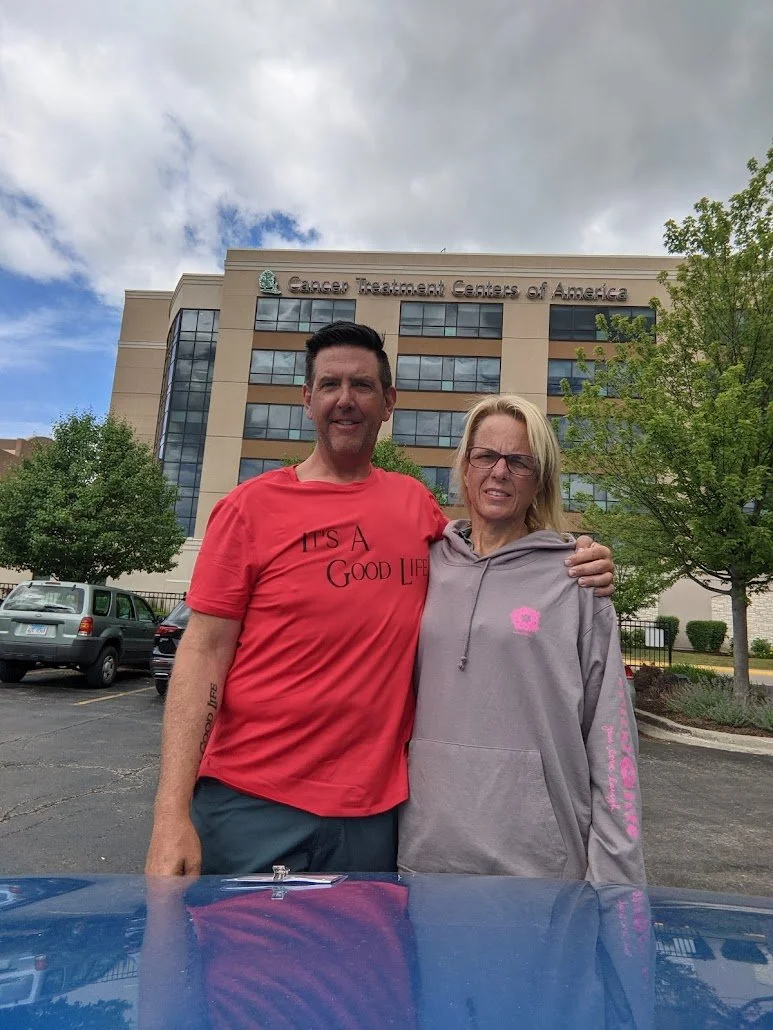
They called and told me to come in within the hour. I had been to this cancer treatment center in Zion, Illinois more times than I can count. An hour and a half from our house in Wisconsin. I knew the drive. I knew the parking lot. I knew the smell of the hallways. And when they called that day and said come now, something in me already knew.
I don't know how I made it in 45 minutes. I was doing 90 miles an hour. Kathryn didn't know what was happening. I hadn't told her what they said on the phone. I just told her we needed to go, and she trusted me, because she always trusted me, even when I didn't deserve it. I was gripping the wheel and staring at the road and trying not to fall apart in front of her while I was driving us to whatever came next.
I still don't know how I didn't get pulled over. I still don't know how I held it together in that car.
A Hallway I Will Never Forget
The doctor was someone we had never met before. They took us to a part of the building we'd never been in. A different wing. A different kind of quiet.
I already knew something wasn't right before we sat down. You don't get walked to a new room with a new doctor when the news is okay. I looked up at him and I just asked it. I said: Is this it? Have we done everything we can?
He wouldn't answer me directly. So I said: We're supposed to be getting on a cruise ship next week. Should we start hospice?
He said: "I would cancel the cruise. You wouldn't want your wife to pass away on the cruise ship."
That was it. Twenty months of fighting and that was how it ended.
We walked out of that room and down those hallways. Those long, long hallways that I had walked a hundred times before, but never like this. I was squeezing Kathryn's hand so hard I don't know how I didn't hurt her. We didn't say a word. There was nothing to say. We were both completely numb. Two people walking through a building in their bodies while something else — something that used to be hope — was leaving them.
There was a metal door at the back of the building. We had been through it hundreds of times over twenty months. I can still hear it. The weight of it. The way it closed behind us.
It was around 2:30 in the afternoon. A cold early April sky, the kind that still carries winter in it even when the calendar says otherwise. But the birds had just started. That first tentative chirping that tells you spring is trying to happen even when the world doesn't feel like it deserves a new season. Spring was arriving. And our life as we had known it was falling apart.
The parking lot was still covered in road salt from winter. I remember that clearly too. That white crust on the asphalt, the kind that lingers well into April in the Midwest because the cold just won't let go.
The second that door shut behind us, we were alone. Just us and a parking lot and that early April sky. I looked at her. She looked at me. And we both knew.
I pulled her into me and we just started to go. Both of us. Right there. She had been losing weight and her legs weren't what they used to be, and I felt her start to fall a little, and I went down with her. We went to our knees on that road salt and it bit right through our clothes and it hurt and neither of us cared at all. I don't know how long we were on our knees in that parking lot. It might have been two minutes. It might have been ten. I have no idea. I just know that we were holding each other on the ground and the world had completely stopped, and nobody walked by, and nobody saw us, and I was grateful for that. It was ours. That moment was completely ours.
The fighting was done. We both knew it. She wasn't going to battle anymore. Now we were going to walk her home.
The Sub Club
We hadn't eaten in twenty-four hours. There was a Jimmy John's nearby. Still numb. Still holding each other's hands. We walked in like two people who were there but weren't really there.
The kid behind the counter had the best energy in the room — big smile, completely unaware. He took our order and then asked us if we'd like to join the Jimmy John's Sub Club. Buy a certain number of subs, get one free.
Kathryn looked right at him.
"I'm not even going to be here a month from now," she said. "This will probably be the last sub I ever have. I don't want to join your club."
The kid just went blank. He didn't know what to do with that. Neither did I, honestly. I was shaking on the inside. I wasn't angry that I couldn't pack for the cruise ship. I was angry that I couldn't give her one more trip. One more escape from cancer. One more time to just live life fully, to be Kathryn out in the world without an IV and a scan and another hallway. I was angry at cancer. I was angry at all twenty months of it. That's the only place my anger had a right to be.
We sat down and ate. It tasted like nothing. Like cardboard. Like a meal we were eating inside someone else's life.
We went back to the car. I got in the driver's seat. Kathryn got in the passenger seat. And we just sat there. Staring at the front of that Jimmy John's, at that kid we had probably just ruined his afternoon. The world was swallowing us both whole. There was no air movement in the car. No music. Nothing. Just the cold and the silence and the cardboard taste still in our mouths.
And I still had to drive us home. An hour and a half. And our kids would be there when we walked through the door.
The Question I Can't Take Back
The drive home was an hour and a half.
We drove north on I-94 and I was staring at the road trying to find words that didn't exist. I told her I was sorry. I told her we'd had such a good run. I promised her she'd do hospice at home, the way she wanted it, and I would make sure of that. She didn't say much. She was looking out the window.
And then I asked her something I had been sitting on for months. Something I had no business asking in that car, on that day, within a few hours of what we had just been through.
I said: "Would you be okay with me trying to find love again someday?"
She didn't turn her head. She didn't say a word. She just kept looking at the road ahead of us.
The silence said everything.
I felt like a complete asshole the rest of the drive home. I still do sometimes. She was my everything. She was my foundation. I had been with this woman since we were fourteen years old. I wasn't asking because I wanted to replace her. I was asking because I was a fifty-year-old man who was terrified of what my life looked like without her in it, and fear makes us selfish in ways we are not proud of later.
I am not proud of it. But I am not going to pretend it didn't happen, either. It is still one of my greatest guilts. I wish I could take it back. Maybe by writing it down, she can forgive me as I finally recognize it for what it was — not selfishness, but terror.
Because here is the truth I mean with everything I have in me: I would have switched places with her. I still believe that. I always will.
Deyana knows I feel this way. And when I say it, she gets quiet and then she looks at me and says: "Please stay with me. I just found you." And my heart melts for how much she loves me. And then the guilt comes right back — because Kathryn is still not here. I carry both of those things at the same time. I don't think that ever fully goes away.
Standing Over Her Bed
Go back with me even further. To July of 2020. To the day they told us she had stage four colon cancer.
Stage four. Terminal. No solution. We could try to extend her life, they said. She could be a mom a little longer, they said. There was no cure. There had never been a cure.
Nobody tells you what to do when you walk back through your front door that night. The hospital doesn't give you a pamphlet for that. They give you the diagnosis and they give you the next steps and they send you home, and then it's just you and the person you love most in the world standing in your kitchen, and everything is different now.
We had lorazepam in the house. I gave her one. I got her settled into bed. And then I stood over her in the dark.
She was my best friend since I was fourteen years old. The person who gave me my children. The person who made me a better man in every way that actually mattered. And I had failed her in so many ways as a husband — I knew that, I carried that — and now I was going to lose her.
I just started bawling. Right there over her bed. I couldn't stop it.
I said: "I would switch places with you right now. I wish I could take this."
I said it again. And again. I was holding her hand and I just kept saying it.
She looked up at me and she didn't know what to say. And then I felt guilty about that, too. Because even then, in that moment, I was making it about me. I was supposed to be there for her and instead I was standing over her bed falling apart, and she was the one who was sick.
To this day, to this very moment, I would still switch places. I had a good life. She deserved to live hers.
Nobody Ever Asked How I Was Doing
For twenty-three months of caregiving, almost nobody asked how I was doing.
Maybe it was because I'm a type-A man who always had a plan. Maybe because I looked strong from the outside — always organized, always with the next step, always in control. Maybe people were just afraid of what I might actually say if they asked.
There were nights I was paddling her from one shore to the other — that's the image I use for caregiving, the exhausting constant work of keeping someone afloat. And when it was finally done, when the kids were asleep, there were nights I would pour two fingers of vodka just to try to get my body to stop so I could sleep. Not every night. In the middle months of the illness, maybe once or twice a month. Toward the end, once or twice a week. Never more than two fingers. And I will tell you honestly: it never helped. Not once. But I did it anyway because I was holding everything together for everyone, and there was nowhere to put any of it.
I also want to say something about faith, because it matters and I think people skip over it. Not everyone reading this has a faith. I understand that. But you need to believe in something when you go through something like this — something larger than yourself. For me, I have a deep faith. I held onto it hard during those twenty months. I reminded Kathryn of it too. And when she passed, the thing that gave me the most comfort — the thing I still hold onto — is that I know where she is. I know she is at peace. That doesn't take the grief away. Nothing takes the grief away. But it gave me ground to stand on when the ground kept moving under my feet. Whatever that is for you — faith, family, a belief in something beyond this moment — find it. Hold it. You are going to need it.
I also want to say the thing that caregivers feel and never, ever say out loud:
After twenty months, I could see how tired everyone was. My kids. Her mother. Her brothers. The people who loved her most in the world. And there comes a point — God, it is painful to even write this — where you know that there needs to be an end. Not because you want to lose her. Because you love her enough to want the pain to stop. Because watching what the weight of it is doing to your children is its own kind of breaking. Because she is ready, even if you are not. Even if you will never be.
I had enormous guilt over that. I still do sometimes.
I Had a Front Row Seat Before It Was My Turn
I need to tell you something about my other life, because it's part of this story.
I'm a financial advisor. Have been for a long time. And long before I became a widower myself, I sat across from people in their most broken moments — people who had just lost their spouse, people still in the fog, people who would come into my office and try to have a conversation about money when their whole world had just collapsed. I have sat with grief professionally for decades. I plan to keep doing it for at least another ten years. It completes me. It brings me joy to help people find their footing. To have a servant's heart toward people in the hardest season of their lives.
I noticed patterns. And those patterns raised my own grief and guilt even more once Kathryn got sick, because I had seen what loss could do to a person and I was terrified I was headed there myself.
Here is what I noticed about men: In their 50s, 60s, 70s — not always, but the majority. A man loses his wife and something in him just stops moving. He comes in looking like himself and sounds like himself but there is a light out behind the eyes and it doesn't come back. Not for years. Sometimes not ever. I would see men who had lost their wives five or six years prior and were still standing in exactly the same place. That scared me. That was the thing I was most afraid of becoming.
Here is what I noticed about women: Most of them moved forward. Not without pain — with enormous pain. But they moved. What they would talk about, the thing that came up again and again, was not money. It was love. It was intimacy. It was missing the person who used to be next to them at night. It was loneliness in a way that surprised even them.
And I would hear from my female widow clients, sometimes even said as a joke: widowers are looking for a nurse and a purse.
I would say it back to them sometimes, just to name it out loud: So if you're a widower looking for love — don't come to a woman as a caregiver and a paycheck. Because that's what she hears, even if that's not what you mean.
I had all of this in my head when Kathryn got sick. I knew what was waiting for me on the other side of her death. And I was determined not to become the man sitting frozen in the chair five years later. But knowing that and living it are completely different things.
The Question She Never Answered
Kathryn passed on May 23rd, 2022, at 6:02 in the evening.
I am coming up on four years without her. The grief gets a little less sharp over time. Not gone. Never gone. But the further I have gotten from that day, the more I have been able to breathe again. And then I feel guilty about that, too. Because I am still here and she is not.
I did find love again. Her name is Deyana.
In the last nine months of Kathryn's life, she mentioned Deyana's name to me three times. Completely unprompted. Out of nowhere. In thirty-six years together she had never mentioned another woman to me like that. Once, just a couple of weeks before that drive down to Zion, she brought up Deyana and said she would be a good person for me to lean on after. That she was a great mom. That she understood disability because her own son had one, and that mattered because of our daughter. She wasn't suggesting anything romantic. She was a mom making sure her child would be taken care of. That's who Kathryn was.
Kathryn knew Deyana from the bleachers. Our kids played hockey together. Kathryn and Deyana would sit in those stands and cheer on their kids side by side, and I think there was a quiet bond between them — two moms raising children with disabilities, understanding something about each other without having to say it. That was it. No deep friendship beyond that. Just a woman she had noticed. A woman she mentioned three times in nine months.
I have said this many times when people ask how Deyana and I found each other: I sometimes think Kathryn was the one who set me up on the blind date.
The question she didn't answer in the car — maybe her silence wasn't a no. Maybe it was a not yet. Maybe she already knew something I didn't. I have tried to believe that. I still try.
But here is where the guilt and the grief hit the hardest, even now: I so desperately wanted to hear those words. I wanted her to turn her head and say it's okay, go live, go love someone. I never heard those words. I never will. And when you can't hear the words — when the person is gone and the silence is permanent — that pain doesn't close. What I said in that car, and what she didn't say back, will be with me for the rest of my life. I made it about me in her worst moment. I know that. I live with that.
I am moving forward. I am not moving on. Those are not the same thing, and I don't think they ever will be. Kathryn is woven into everything I do. My children. My work. The reason this website exists. The reason I still cry sometimes, nearly four years later, when I sit down to write.
She didn't want to be forgotten. She never will be.
A Few Things I Know Now That I Didn't Know Then
I am writing this as someone who has been through it. As a widower. As a caregiver. And as a person who spent years sitting across from widows and widowers in a professional setting, watching what loss does to people up close.
Here is what I would tell you:
Do something you're scared of. Every single day. I used to drop my kids off at school in the morning, get out of the car, give them a hug, and say: do something you're scared of today. A few months after Kathryn passed, when the grief and guilt were at their highest, I remembered I told my kids that. So I started doing it myself. Small things. Things that made me feel something other than numb. That's where purpose starts to come back. And if you want to shrink your problems, grow your purpose.
Ask yourself the role reversal question. If the situation were reversed — if you were the one who had left and they were the one still standing — what would you want for them? Would you want them to stop living? To stay frozen? I know exactly what I would want for Kathryn. I would want her to feel the sun. I would want her to find joy again. I would want her to live wholly. I have to believe she would want the same for me. I choose to believe that every day.
If you do find love again, do not try to replace the person you lost. The person you were with your first spouse is not the same person you are now. You met your spouse at a completely different time in your life, when you were a completely different person. Watching someone pass away changes you in ways you cannot fully see until later. I had been with Kathryn since I was fourteen. She passed when she was 52 and I was 50. I was not the same man I was at 14. Would we have even dated if we had just met at 50? I honestly don't know. We had changed that much.
Don't try to fit someone new into the shape of the person you lost. Find the person who matches who you are now. Kathryn and Deyana are two completely different people. Two things in common: both incredible mothers, both passionate. That's where the similarities end. In every other way they are opposites. And somehow, in both cases, it works. I've had two versions of myself. You may have more than one version too. Be open to that.
Understand that your old life will change — and you are not crazy for grieving that too. I hear this again and again from clients, and I saw it in myself. After you lose a spouse, friend groups collapse. The places you used to go feel wrong. The couple you double-dated with stops calling. The neighborhood feels different. The church might feel different. The whole landscape of the life you had built together starts to shift in ways nobody warned you about.
Here is the hard truth: many of us don't only lose our spouse. We also lose the life we had built around them. And what can feel like abandonment — because it is, in a way — is that the people around us often can't see us without our spouse. So unconsciously, quietly, they pull back. Not out of cruelty. Out of discomfort. Out of not knowing what to say or who you are now without the person who used to stand beside you. And so they disappear. And you are left grieving two things at once: the person, and the world that was built around them.
If this is happening to you: you are not crazy. You are not imagining it. It happens to almost everyone, and almost no one talks about it. Your friend group may change. It should change. The people who can walk with you into this next version of your life are not always the people who were comfortable with the old one.
And maybe it won't be romantic love that finds you. Maybe it will be a circle of people who see you differently than your old friends did. A different church. A new community. A purpose you never expected. A version of your life that looks nothing like what you planned — and turns out to be exactly what you needed.
The person you are after loss is not lesser. They are not broken. They are not a diminished version of who you were before. They are someone who has been through the worst and is still standing. Give that person room to grow. Give them permission to want things. Give them permission to be surprised by joy.
If you want to shrink your problems, grow your purpose.
Grief sucks. I will say that plainly and without apology. Guilt moves in right alongside it and makes itself at home and tells you that you don't deserve to feel okay again. Don't listen to it. You are allowed to keep living. More than allowed — you are supposed to.
Kathryn loved to be outside barefoot. Grass, dirt, concrete, gravel — it didn't matter. She would kick her shoes off the second she could. When the bottoms of her feet were at their dirtiest, she was at her happiest. She was fully alive in those moments. Fully present. Fully herself.
She doesn't get to do that anymore.
So you go do it for her. Go outside. Kick your shoes off. Feel the cold ground, the warm grass, whatever the season has to offer. Get your feet dirty. Feel something real under you. Start living again — messily, imperfectly, one barefoot step at a time.
Do it in honor of the person you lost. Do it for the people who still need you here. Do it because they would want you to, even if you never got to hear them say it.
It's a Good Life.
Marc Messinger
Widower. Caregiver. Father. Husband 2.0 - I hope I do better the 2nd chance at life!
If this article was helpful, you can find all of my writings and recordings at mylifetransitionsguide.com
Browse More