Episode 1: When Life Breaks You
Transcript
Episode 1 of A Calm Place
By Marc Messinger
Episode 1 – When Life Breaks You
A Calm Place
By Marc Messinger
If you’re listening to this, let me say something clearly, right up front:
You didn’t end up here by accident.
You’re here because something in your life has shifted — broken open — and you’re not sure how to stand inside it yet.
Maybe nothing looks broken from the outside, but inside everything feels unsteady.
Maybe your days are filled with decisions you never asked to make… conversations you never wanted to have… responsibilities you were never prepared for.
Maybe you wake up already tired — not just physically, but emotionally — bracing yourself for another day of holding it together.
Or maybe something happened so suddenly, so completely, that it knocked the breath out of you — and you’re still trying to understand how the world kept moving when yours stopped.
If you’re listening and thinking, “I don’t even recognize my life anymore,”
you’re not weak.
You’re human.
If you give me the next twelve minutes, I won’t promise to fix anything.
But I will give you a philosophy — something steady to hold onto.
Think of it like this:
When you’re caught at sea in a storm and you can’t see the shoreline, what you need first isn’t speed or answers.
You need direction.
This four-part series is meant to be that point of light — a lighthouse — something you can orient toward when everything feels chaotic and overwhelming.
You may have found this recording on my website, mylifetransitionsguide.com.
Or maybe someone quietly handed it to you — a friend, a social worker, a nurse, a chaplain — and simply said,
“Take a few minutes. This man might get you.”
That’s exactly how I hope these recordings travel.
Person to person.
When someone needs a calm voice more than another set of instructions.
This is the first recording in a short series called A Calm Place.
At its core, this series explores one question most people are never taught how to answer:
What do you do when life changes without your consent — and how do you find your footing again?
Losing Control Isn’t About the Obvious Things
When people talk about losing control, they often point to what’s visible — the paperwork, the decisions, the responsibilities that suddenly pile up.
But that’s not what hurts the most.
What really shakes us is losing our sense of direction.
The feeling that your life has slipped out of your hands.
That you’re reacting instead of choosing.
That you don’t know what matters anymore — or where to put your energy first.
What I hear most often isn’t, “I’m overwhelmed.”
It’s this:
“I am so lost.”
“I feel completely out of control.”
“I don’t even know if I’m going to survive this.”
So let me say this clearly — and I want you to hear it emotionally, not just logically:
There is nothing wrong with you.
This is what it feels like when life changes without your consent.
The First Time I Lost Control
The first time I truly lost control was when I was sixteen.
I’m not going to get into the medical diagnosis today — that’s a story for another time.
What matters here is the experience.
I lost my hearing.
Then I lost my sight.
I moved from hospital rooms to rehab centers, from Marshfield to Mayo Clinic — surrounded by uncertainty, fear, and questions no one could fully answer.
What stayed with me wasn’t the procedures or the medicine.
It was the feeling.
I was young.
I was scared.
And I was powerless.
I watched adults — men who had lived full lives — face the same fear I was facing: losing control.
That moment quietly shaped everything that came after.
Because I learned something early:
We can’t control outcomes.
But we can learn how to steady ourselves when life turns without permission.
Losing Control as a Parent
Years later, I felt that loss again — this time as a parent.
Our daughter was diagnosed with central core muscular dystrophy.
I remember sitting in that room as the doctor spoke, watching the clock continue to tick while time stood still.
Every instinct in me wanted to trade places with her — to carry it for her.
But I couldn’t change the diagnosis.
So we learned how to live with it.
At the time, I thought I was simply raising a strong daughter — because that’s what parents do.
I didn’t realize I was preparing her for how strong she would need to be later — for what was coming.
I’m grateful now that I was the caregiver in our home — that she saw strength modeled, not as perfection, but as perseverance.
Because strength isn’t something you explain.
It’s something you live — and hope the people you love absorb.
Caregiving Changes You
Caregiving doesn’t break you all at once.
It wears you down slowly.
It’s the vigilance.
The mental load you carry everywhere.
The exhaustion no one sees.
Caregivers don’t collapse.
They fade.
And caregiving changes you — just like loss does.
The Storm That Changed Everything
My third storm came when my wife, Kathryn — my partner of thirty years — was diagnosed with stage-four colon cancer.
It was July of 2020.
The world was already unraveling.
Doctors and nurses were fighting battles of their own — not just against illness, but against layers of bureaucracy and isolation brought on by COVID.
Many days, it felt like we were fending for ourselves in unfamiliar waters.
It was during that season — for the first time — that I consciously used the philosophy I’m about to share with you.
We set small, intentional goals across the four foundational areas of life — not to control outcomes, but to give ourselves true north.
Something steady to point toward in a choppy, unpredictable sea.
She lived twenty-three meaningful months.
Together, we set thirty-seven small goals.
She completed thirty-six of them.
Eventually, she entered hospice in our home.
For us, it was the right choice — for her comfort, for our children, and so she could be in a place that felt safe.
She died in our bed — with our three children and me holding her — our dog lying quietly at her side.
It was a beautiful death.
And it was far too soon.
The Quiet Middle of the Hurricane
I thought that was the end of the storm.
I was wrong.
It was the middle of the hurricane — the quiet part — where the real destruction hadn’t shown itself yet.
In the months that followed, I lost not just my wife, but my sense of purpose.
Our children and I were changed forever.
We were lost.
Scared.
Angry.
In denial.
Trying to understand a life that no longer made sense.
Returning to the Framework
Months later, I returned to the same philosophy — this time for myself.
I had to be honest about where I was.
Not rebuilding.
Not thriving.
Just surviving.
And that honesty became the first rung on the ladder back up.
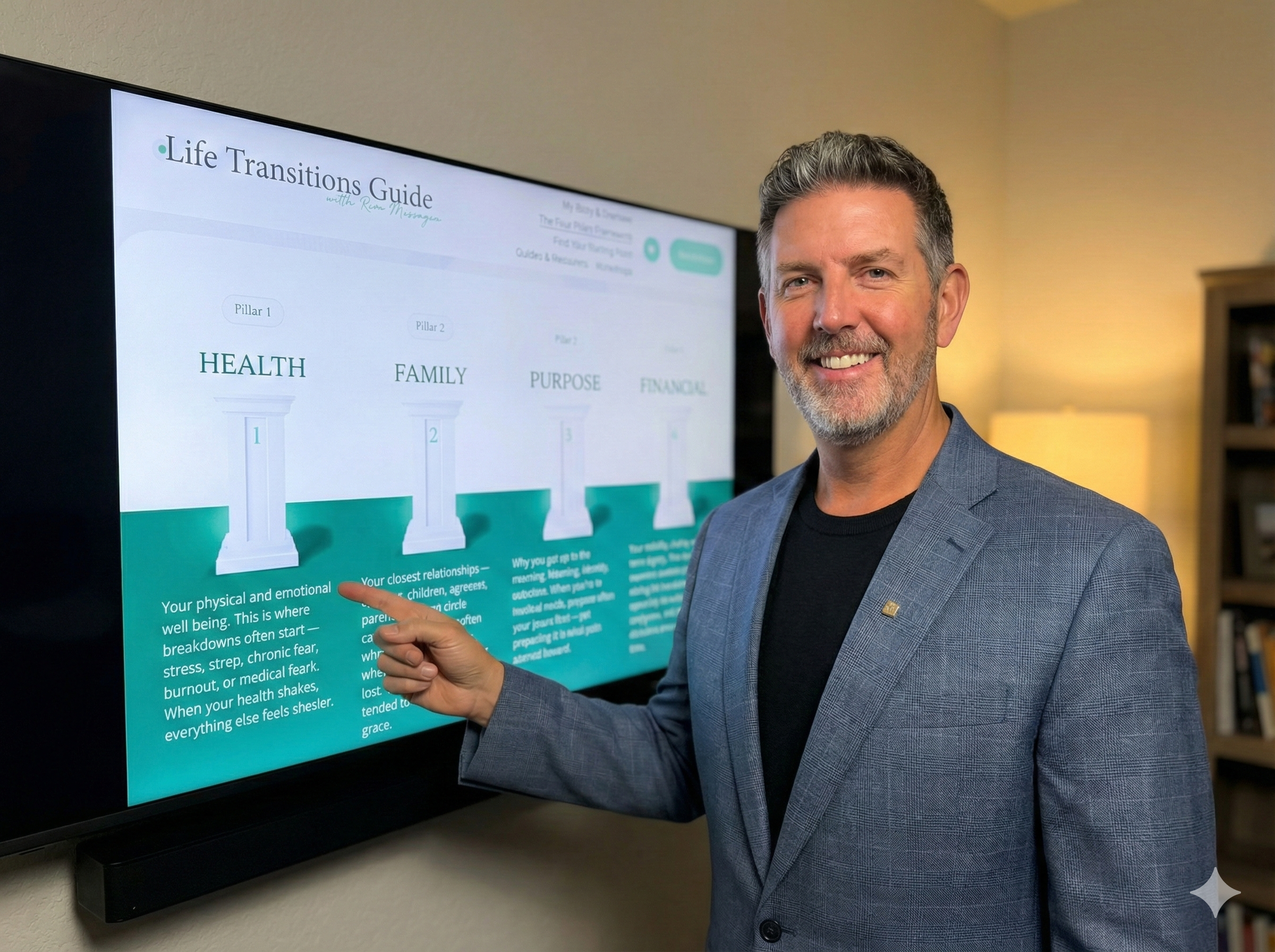
Looking back, every storm broke the same parts of my life:
Health
Family
Purpose
Finances
I didn’t build this framework because I wanted to.
I built it because I needed one.
Those four areas became anchors.
Together, they formed a compass.
Life moves in stages — especially during crisis:
Survival → Stability → Significance
Most people aren’t failing.
They’re just asking too much of themselves too soon.
The real question isn’t,
“How do I fix everything?”
It’s,
“Where am I right now — and what’s the next small step?”
A Calm Place to Start
That’s why this series exists.
This episode is about orientation.
The next three will give you structure.
In Episode Two, I’ll walk you through the Four Life Pillars — not as a checklist, but as a way to understand where you are today and where your energy belongs first.
In Episode Three, we’ll talk about Survival, Stability, and Significance — and why timing matters.
And in Episode Four, I’ll give you a simple visual guide — a Compass — to help you set true-north goals again.
You can find that guide at mylifetransitionsguide.com under A Compass Guide.
But for now, hear this:
You are not broken.
You are not behind.
And you don’t have to navigate this season alone.
If all you did today was listen — that’s enough.
It’s a Good Life.
Browse More