Episode 4: The Compass: How to Take Your Next Step
Transcript
Episode 4 – The Compass: How to Take Your Next Step
Hello — and thank you for being here.
My name is Marc Messinger, and you can find all of these recordings and resources at
mylifetransitionsguide.com.
If you’ve made it to Episode 4, I want you to pause for just a moment and recognize something important:
You’re still here.
That matters.
Because when life breaks open — through loss, illness, caregiving, or a sudden change you didn’t choose — continuing to listen, reflect, and search for footing is not nothing.
It’s effort.
It’s courage.
And it’s enough for today.
Why You Don’t Need a Map — You Need a Compass
When life is predictable, we plan with maps.
We set timelines.
We make long-term plans.
We assume tomorrow will behave like yesterday.
But when life breaks, maps stop working.
Because maps require certainty —
and crisis destroys certainty.
That’s why what you need right now isn’t a map.
It’s a compass.
A compass doesn’t tell you how fast to move.
It doesn’t tell you where you’ll end up.
It simply helps you orient yourself — so you don’t keep walking in circles while exhausted.
How the Compass Fits Into Everything We’ve Covered
In Episode 1, we talked about how life can break you — and how survival doesn’t feel dramatic. It feels quiet, disorienting, and heavy.
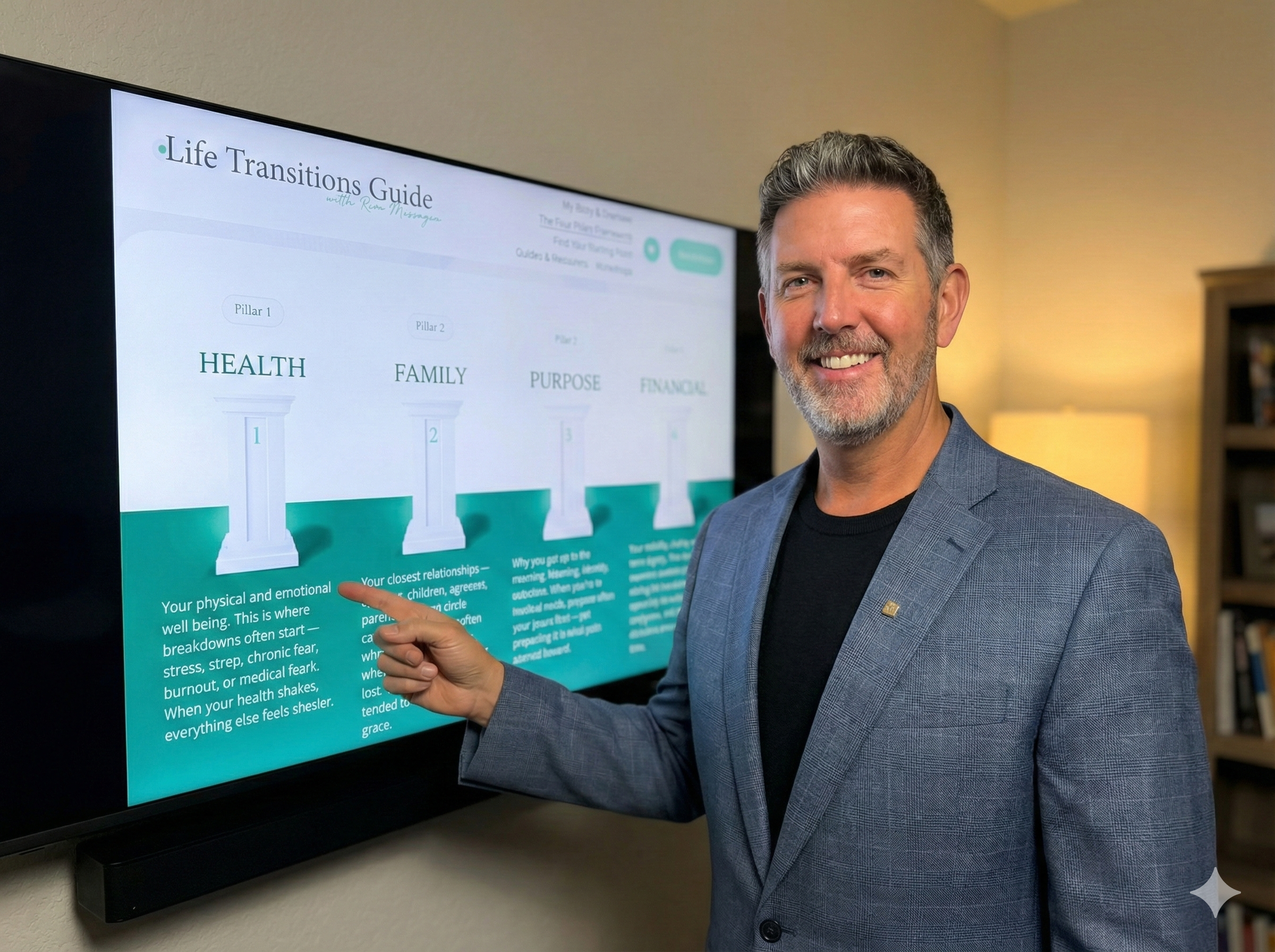
In Episode 2, we talked about the Four Life Pillars — Health, Family, Purpose, and Finances — and how when even one pillar cracks, the whole structure feels unsafe.
In Episode 3, we talked about the pyramid:
Survival at the bottom
Stability in the middle
Significance at the top
And how survival is not a failure — it’s a place you don’t choose, but everyone visits.
This episode brings all of that together.
Because once you understand where you are, the real question becomes:
What is one small step I can take — without rushing — that brings steadiness back?
The Compass Uses the Same Four Pillars
The compass uses the same four pillars we’ve been working with all along:
Health
Family
Purpose
Finances
But instead of asking, “How do I fix my life?”
it asks a quieter, safer question:
“What is one small, attainable step that brings stability — not progress — today?”
That distinction matters.
In survival mode, progress is the wrong goal.
Stability is the goal.
What a “Next Step” Actually Looks Like
A next step is not a leap.
It’s not a reinvention.
It’s not a decision that locks you into anything.
A next step is:
one conversation
one boundary
one appointment
one habit
one honest sentence written down
Small enough that your nervous system doesn’t panic.
Clear enough that you can actually complete it.
If a step creates urgency, pressure, or fear —
it’s not the right step yet.
Examples of Compass Steps When You’re in Survival
This is where the Compass Guide on my website comes in.
On the second page of mylifetransitionsguide.com, you’ll find a visual Compass Guide — along with a downloadable worksheet — designed to help you identify where you are and choose small, attainable steps that bring stability.
Here’s what those steps might look like when you’re in survival mode.
Health
Not fixing your health.
Not optimizing it.
Just stabilizing it.
Examples:
Drink a full glass of water first thing in the morning
Step outside for two minutes of sunlight
Go to bed 30 minutes earlier than usual
These are signals to your nervous system:
I’m not powerless. I have some control.
Family
This pillar is about support — not performance.
Examples:
Tell one person: “I’m not okay.”
Ask for help with one specific task
Set one boundary that reduces emotional drain
That’s not weakness.
That’s load management.
Purpose
Purpose in survival mode is not inspiration.
It’s orientation.
Examples:
Write one sentence answering: “What matters today?”
Narrow your focus to getting through the next 24 hours
Allow survival itself to be enough for now
Purpose doesn’t need to feel big.
It needs to feel true.
Finances
This is where overwhelm often spikes — and clarity matters most.
A survival-mode financial step is not making decisions.
It’s gathering.
Examples:
Collect all bank statements, credit card statements, bills, and financial paperwork
Put everything — even the things that scare you — into one folder or one place
Don’t organize it. Don’t analyze it. Just gather it
That alone is a win.
Because chaos feels overwhelming when it’s scattered.
It becomes manageable when it’s contained.
Why Writing Your Goals Down Matters
This part is critical.
If your goals stay in your head, they swirl.
They grow heavier.
They keep you trapped in survival.
When you write them down, something changes.
Your brain stops treating them like threats —
and starts treating them like steps.
That’s why the Compass Guide is written.
That’s why it’s visual.
That’s why it’s downloadable.
Because clarity doesn’t come from thinking harder.
It comes from externalizing the chaos.
A Personal Moment — Why This Matters to Me
I want to circle back to myself for just a moment.
When I was in survival mode — after losing my wife — I didn’t realize it right away.
I thought I was okay because I was functioning.
But emotionally, I was standing in the center of a hurricane — not realizing the back half of the storm was still coming.
When survival finally set in, every day wasn’t living.
It was breathing.
That’s when I used this compass myself.
And what became clear — painfully clear — was that my Health Pillar had to come first.
Not fitness.
Not discipline.
Control.
So I set one rule:
I was going to take back the first 90 minutes of every day for myself.
That was my life ring.
And inside those 90 minutes, the goals were simple:
Drink 12 ounces of water
Get two minutes of sunlight on my body
That sunlight wasn’t about vitamin D.
It was psychological.
It told my nervous system:
I have agency.
I have control.
I am not drowning today.
That’s how survival begins to loosen its grip.
A Quiet Professional Perspective
I’ll say this briefly.
In my day job, I’m a financial advisor.
I’ve spent my career working in behavioral finance and human decision-making.
And here’s what I know to be true:
People make their best decisions after they feel steady — not before.
That’s why this work isn’t about advice.
It’s about orientation.
If you ever want to know more about my professional background, you’re welcome to look me up on your own.
This space stands on its own.
The Most Important Thing to Remember
You don’t climb out of survival by pushing harder.
You climb out by choosing steadiness over speed.
And the moment you realize:
I need help
I need structure
I need a pause
You’re already moving.
That awareness is the first step.
Closing
If this is the first time you’ve realized,
“I’m in survival mode,”
that doesn’t mean you’re behind.
It means you finally see where you are.
And that’s where healing actually begins.
You can find the Compass Guide, the downloadable worksheet, and all of these recordings at
mylifetransitionsguide.com.
Wherever you are today —
notice it.
Respect it.
And take the next small step when it feels steady.
It’s a Good Life.
Browse More