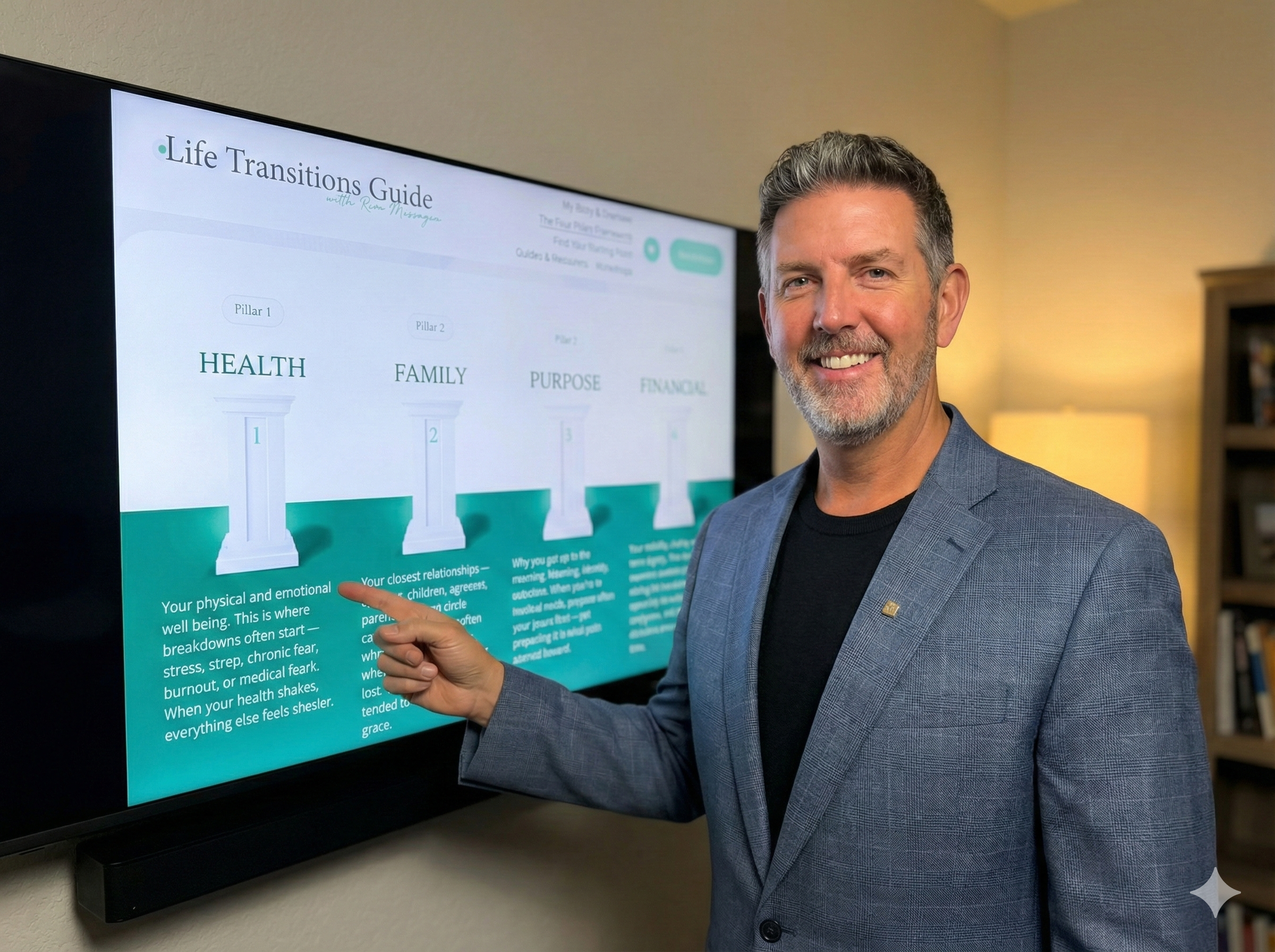
Episode 3: The Four Life Pillars
Transcript
Hey — thanks for tuning in to Episode 3: The Four Life Pillars.
My name is Marc Messinger, and you can find all of these recordings and resources at mylifetransitionsguide.com.
I’m really glad you’re here.
If you’re listening to this, there’s a good chance life has felt unstable lately.
Not dramatically broken — just… off.
Like the ground underneath you isn’t as solid as it used to be.
And when that happens, most people don’t need motivation.
They don’t need advice.
They don’t need someone telling them what they should do next.
They need something quieter.
Something that helps them slow things down…
organize the chaos…
and begin trusting their own judgment again.
That’s what this recording is about.
I’m not here to ask you to trust me.
I’m here to offer a simple framework — one that has helped me personally and professionally — that helps people start trusting themselves again.
The Pavilion
Let me explain it this way.
All of us have been in a park and seen one of those pavilions.
Maybe you’ve been under one for a birthday party, a graduation, or a family celebration.
You go under that pavilion because it provides shade.
Protection.
A sense of safety.
Even if you notice a pillar that doesn’t look perfect, you still feel okay standing there — especially if the weather starts to change.
But now imagine something different.
You’re standing under that pavilion and you realize two or three of the pillars are cracked.
If storm clouds roll in, you’re not staying there.
You’re running to your car — because suddenly, that structure isn’t protecting you anymore.
That’s exactly how life works.
The Four Life Pillars
That pavilion is your life.
And the four pillars holding it up are:
Health
Family
Purpose
Finances
When one pillar weakens, the whole structure feels unsafe — even if the others are still standing.
The goal isn’t to fix everything at once.
The goal is to identify which pillar needs attention first.
Pillar 1: Health
Health is always the first pillar — because without it, nothing else works well.
And health has two sides:
Physical health
Mental and emotional health
In Episode 1, I mentioned watching World War II veterans — how when their bodies failed, or when their minds failed, it changed the entire trajectory of their lives.
The same thing happens to us.
When you’re exhausted, overwhelmed, anxious, or not sleeping — every decision feels heavier than it should.
In grief and caregiving, health is often the first thing sacrificed.
People stop sleeping.
They skip meals.
They live on adrenaline.
This isn’t about fitness goals.
It’s about capacity.
If your nervous system is overloaded, clarity is impossible.
Pillar 2: Family
The second pillar is Family — and this one needs clarity.
Family is not just blood.
Family is your crew.
It’s:
the people you lean on
the people you protect
the people you feel responsible for
And here’s a hard truth.
Family can help you —
and family can hurt you.
Not because they’re bad people, but because stress, fear, and pain change dynamics.
Being family does not mean unlimited emotional access to you.
Loss, illness, and caregiving strain this pillar deeply.
Roles change.
Expectations shift.
Silence creeps in.
Sometimes this pillar cracks not because of conflict — but because no one is saying out loud how hard things really are.
Stability here often begins with permission to say:
“This is hard — and I don’t have to carry it alone.”
Pillar 3: Purpose
The third pillar is Purpose — and it’s often misunderstood.
Many people think their purpose is:
taking care of their family
caring for a sick loved one
their job
Let me be very clear with you.
Those are responsibilities.
They are not purpose.
Purpose is what makes you wake up in the morning.
For me, my family is the foundation of my life — the reason I do everything.
But my purpose goes deeper.
I realized, in survival mode, that I have a servant’s heart.
That matters to me.
Here’s why this is important.
If your entire purpose is wrapped up in a person, someday that person may not be there.
If your entire purpose is wrapped up in a job, someday that job won’t be there.
And if your purpose disappears when something external disappears — it was never anchored deeply enough.
If you don’t know your purpose yet, that’s okay.
Every one of us has a supercomputer in our pocket.
Ask questions.
Reflect.
Even use artificial intelligence as a thinking partner to explore what brings you meaning.
Purpose doesn’t mean passion or productivity.
It means orientation.
In survival mode, purpose is small:
get through today
show up
take one step
That counts.
Purpose doesn’t need to be inspiring.
It needs to be true.
Back to the Pavilion
So go back to that pavilion.
If two or three pillars are cracked, of course you don’t feel safe standing there.
The work isn’t rebuilding the entire structure overnight.
The work is stabilizing one pillar at a time.
Pillar 4: Finances
The fourth pillar is Finances.
And in my experience, this is usually the loudest pillar — but rarely the first one that actually needs attention.
Money gets loud because decisions are forced.
Bills still show up.
Benefits have deadlines.
Care costs escalate.
Income changes — sometimes overnight.
And when the other pillars are cracked, those financial decisions feel urgent… even panicked.
Here’s what I’ve learned over time.
In my day job, I’m a financial advisor.
I sit across from people one-on-one, sometimes in small groups of ten, and I’ve taught classes in rooms of a hundred.
And again and again, I’ve seen the same pattern.
When people are exhausted…
when family dynamics are strained…
when purpose feels unclear…
financial clarity is the hardest thing to achieve.
That’s why rushing financial decisions in emotional fog so often leads to regret — not because people are careless, but because their foundation isn’t steady yet.
But here’s a quiet truth I want you to hear.
Once the other pillars are stabilized — even just a little — the financial pillar is often the fastest one to repair.
Clarity returns quickly when the noise dies down.
And if someday you decide you need expert guidance, that’s okay.
But this work isn’t about trusting me — or any professional.
It’s about helping you trust yourself enough to know when to pause, when to listen, and when to ask for help.
A Quick Note on Context
This framework is shaped by my background in behavioral finance and human decision-making — that’s the lens I’ve spent my professional life working through.
But these recordings aren’t about my day job.
They exist to support you — right where you are.
If at some point you’re curious about my professional background, you’re welcome to look me up on your own.
This space stands on its own.
Closing
People have told me — whether in rooms of a hundred, ten, or one-on-one — that this framework helped them feel steadier again.
Not because they trusted me.
But because it helped them start trusting themselves.
You can find the rest of these recordings and resources at mylifetransitionsguide.com.
In the next episode, we’ll talk about moving from survival to stability — and why that transition takes longer than most people expect.
For now, notice the structure.
Notice the pillars.
And take the next small step. It’s a Good Life.
Browse More